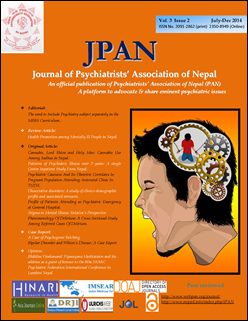
Psychiatric Caseness and its Obstetric Correlates in Pregnant Population Attending Antenatal Clinic in TUTH
Abstract
Background: Prevalence rates for psychiatric disorders during pregnancy have been found to range from 6-13%. Psychiatric caseness during pregnancy not only affects the mother but also affects the health and development of the child. Various factors have been found to be associated with psychiatric caseness in different cultural and social settings including obstetric history.
Objective: To evaluate the relation of obstetric history in pregnant population with psychiatric caseness.
Methods: This is a cross sectional study with a total of 300 sample collected within 6 months in antenatal clinic of obstetric OPD, TUTH using semi-structured proforma and SRQ-24.
Results: 15% of the pregnant women could be labeled as psychiatric cases. Trimester and, complication during current pregnancy showed statistically significant association with psychiatric caseness.
Conclusion: As 15% of pregnant ANC attendees were found to be having psychiatric illness, it can be recommended that pregnant females be routinely screened for the possibility of psychiatric caseness especially if it is the first trimester or complication during this pregnancy is noted.
J Psychiatric Association of Nepal Vol .3, No.2, 2014, pp:20-24
DOI: http://dx.doi.org/10.3126/jpan.v3i2.12383
Author Biographies
J Regmee, Kathmandu
Consultant Psychiatrist
S P Ojha, Department of Psychiatry, TUTH Kathmandu
Associate Professor
M Chapagain, Department of Psychiatry, TUTH Kathmandu
Associate Professor
P Tulachan, Department of Psychiatry, TUTH Kathmandu
Lecturer
N Ojha, Dept of Obstetrics & Gynae, TUTH, Kathmandu
Lecturer
How to Cite
Regmee, J., Ojha, S. P., Chapagain, M., Tulachan, P., & Ojha, N. (2015). Psychiatric Caseness and its Obstetric Correlates in Pregnant Population Attending Antenatal Clinic in TUTH. Journal of Psychiatrists’ Association of Nepal, 3(2), 20-24. https://doi.org/10.3126/jpan.v3i2.12383
License
This license enables reusers to distribute, remix, adapt, and build upon the material in any medium or format, so long as attribution is given to the creator. The license allows for commercial use.